

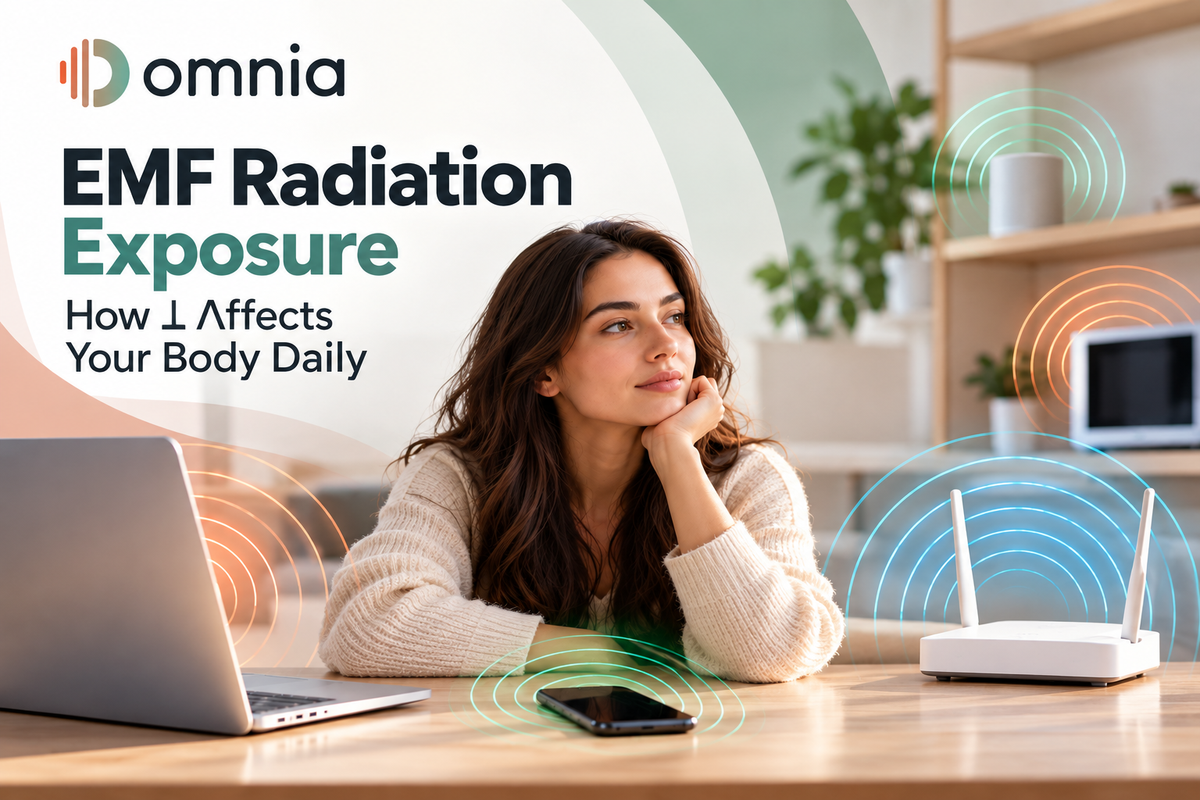
Your phone is not the only thing giving off EMF radiation today. Your WiFi router, your laptop, your smartwatch and the wireless network at your office are all doing it too, and none of them ever switch off.
EMF radiation exposure comes from every wireless device you own. It is invisible, it is constant, and unlike most environmental exposures, you cannot simply avoid it. Even without a phone in your hand, third party radiation fields reach you at the bus stop, at school, in shops and at work. The real question worth asking is not whether you are exposed to EMF radiation. It is how well your body is handling that exposure, day after day, year after year.
This guide breaks down what EMF radiation actually is, where it comes from, the three specific factors that determine how much of it reaches your body, and what people are doing about it.
What Is EMF Radiation and Where Does It Come From
EMF stands for Electromagnetic Field. EMF radiation refers to the electromagnetic fields given off by wireless technology such as mobile phones, WiFi routers, laptops, tablets, smartwatches and smart home devices. These fields are part of daily life now, built into homes, schools, offices, cars and public spaces.
EMF is also referred to as RadioFrequency Radiation (RFR). And you can measure it using an RF Meter. In this video showing the levels of RFR coming out of wireless headphones, you will see that the levels jump from 0.01 to over 200 (which is an increase of 20,000 times!).
A generation ago, wireless radiation exposure was limited mostly to television and radio broadcast signals, plus early analogue mobile phones used for short calls. Today, an average household runs a WiFi router continuously, several smartphones, laptops, tablets, smart speakers, wireless doorbells and often a smart TV, all emitting wireless radiation at the same time, around the clock. Add in the wireless networks in every coffee shop, school, airport and office building, and it becomes clear why EMF exposure is now considered a constant background feature of modern life rather than an occasional event.
The human body is electric. It relies on electrical activity for processes including nerve signalling and heart rhythm. Omnia's approach is based on the view that external electromagnetic fields may interact with this electrical activity in ways that deserve further investigation. As part of its own research and testing approach, Omnia references methods including heart rate variability, live blood analysis and bio resonance testing when exploring responses to wireless radiation.
Why EMF Exposure Has Increased So Sharply
It helps to understand why this conversation is happening now rather than twenty years ago. Wireless technology has gone through several generations, from 2G to 3G, then 4G, and now 5G with 6G already being planned. Each generation has increased the frequency range used to carry data, moving from a narrow band suited to voice calls to a much wider spectrum needed to support video streaming, cloud computing and billions of connected devices.
The number of wireless devices and networks people encounter in everyday life has increased significantly over recent decades. At the same time, questions continue to be researched around the long term effects of continuous exposure to radiofrequency fields. This uncertainty is one reason some people choose to take practical steps to manage their everyday EMF exposure.
Download the Omnia EMF Protection eBook
Want to learn more about EMF radiation and the reasons behind a precautionary approach to wireless exposure?
EMF Radiation: Top 10 Reasons Why You Need To Protect Your Body
The Three Factors That Decide Your EMF Radiation Exposure
Almost nobody living a modern lifestyle can avoid these three risk factors entirely, but understanding them is the first step toward managing wireless device radiation more deliberately.
Risk Factor One: Exposure Time
Many adults spend several hours a day using wireless devices such as phones, laptops and tablets. For some people, exposure continues overnight when phones are kept close to the bed or within arm's reach. Some people reach closer to twelve hours once work, entertainment and personal use are added together. A significant number of people also sleep with their phone under the pillow or within arm's reach on the nightstand, which extends wireless device radiation exposure into the hours the body is supposed to be resting and repairing itself.
Exposure time compounds. A single ten minute phone call is very different from six hours of continuous laptop use with WiFi running in the background, a phone in a nearby pocket, and wireless earbuds delivering signal directly next to the head for hours at a time.
Risk Factor Two: Proximity
The closer you are to a wireless radiation source, the stronger the field acting on your body. This is one of the more overlooked aspects of EMF exposure, because people tend to think about whether they are using a device, not how close it physically is to their body while it is switched on.
Typing on a laptop keyboard with the device resting on your lap, holding a phone directly to your ear during calls, or keeping a phone in a trouser or shirt pocket for hours all put you in close, sustained contact with the radiation field. Wireless earbuds sit directly in or on the ear canal, which is a uniquely close and prolonged form of proximity that did not exist before earbuds became mainstream. Even a WiFi router sitting on a desk a few feet from where someone works all day represents constant, close-range exposure that is easy to forget about because the router is not something you are actively "using."
Risk Factor Three: Signal Strength
The radiofrequency output of any wireless device can be measured with an RF meter, and it is not a fixed number. With 5G rollout continuing and heavier daily use of data-hungry media like video streaming, video calls and cloud gaming, The radiofrequency output of a wireless device can be measured with an RF meter and can vary depending on factors such as the device, network connection and how it is being used. This means signal strength is not necessarily constant throughout a normal day, which means signal strength varies constantly throughout a normal day depending on what a device is doing in the background. What’s more, the bandwidth capacity of 5G celltower networks can potentially increase from 2.4Ghz (the limit of 4G) to over 60Ghz with 5 & 6G towers. This is a 25 times increase in RFR levels!
Why This Deserves Attention, Not Alarm
It is worth being careful about how this topic gets discussed, and this guide is written with that in mind. Some studies have investigated potential biological effects of EMF exposure, particularly in animal research, and the volume of that research is significant enough that organizations such as BioInitiative and the National Toxicology Program have both published findings worth reading directly rather than through secondhand summaries. That is a reason to pay attention and to be sensible about exposure, rather than a reason to panic.

Long- term human effects of continuous, lifelong wireless exposure remain an active area of research, and the honest answer is that there is still genuine scientific uncertainty about how decades of exposure interacts with the human body. Claiming otherwise, in either direction, does not serve anyone well. What is clear and uncontroversial is that exposure time, proximity and signal strength are all factors an individual can actually influence, whether through adjusting habits, creating more distance from devices when they are not in active use, or adding a layer of protection to the specific devices used most.
The Electromagnetic Spectrum Classification Worth Knowing About
EMF radiation from wireless devices is officially classified as non-ionizing and non-thermal, meaning that, according to physics principles that some are saying are now outdated, it does not carry enough energy to break chemical bonds the way ionizing radiation, such as X-rays, does. This classification is often used to suggest that wireless radiation is essentially harmless below certain heat-related thresholds. However, some researchers argue that focusing only on heat effects misses other biological interactions that non-ionizing fields may still have with living tissue, which is part of why this remains an active area of scientific debate rather than a settled question.
What People Notice When They Take Action on EMF Exposure
People who take active steps to manage their daily EMF radiation exposure often report a range of noticeable changes. These commonly include better sleep, fewer headaches, less brain fog, improved energy levels throughout the day, fewer tingles or a warm sensation in the hands after long device use, less heat coming off devices during use, reduced stress and irritability, and a generally better mood and sense of hormonal balance.
This is exactly the gap that Omnia's ORB Sticker range was designed to fill. Rather than blocking wireless signal, which can interfere with device performance, Omnia's harmonizer technology changes the vibrational quality of the EMF field emitted by a device, aiming to bring it into resonance with the body's own electrical field. You can read the full reasoning and independent test methodology behind this approach on the Omnia Science Section section, and see the actual before and after results from heart rate variability, live blood analysis and water structure testing on the Omnia Test Results page.
How the Harmonizing Approach Differs From Blocking
There are broadly two categories of EMF protection product on the market: ‘blockers’ and ‘harmonizers’.
Blockers work by physically shielding a device or a person from radiofrequency signal, which reduces the field strength reaching the body but can also interfere with reception, data speed and battery life, since the device compensates by boosting its signal output to maintain connection.
Harmonizers take a different approach. Rather than reducing the strength of the field, they aim to change its vibrational character so the body's own electrical field responds to it differently. Omnia's ORB Sticker Packs are built on this principle, using what the company calls Deca Energy technology to imprint a stabilizing pattern into the device's radiation field without touching signal strength or data performance. Full details on how this mechanism is designed to work are available on the How Omnia Technology Works page.
There is also a major drawback to ‘blocking’ EMF, which is that if you imagine that you buy a phone case that blocks the radiation, as soon as you open the case to use the phone you are immediately exposed to the EMF, and you are touching it. You have done nothing to treat the source of the problem, you just tried to block the problem momentarily.
Which Devices in Your Home Matter Most
Not every wireless device contributes equally to your daily EMF radiation exposure. The devices that matter most are the ones combining all three risk factors at once: long exposure time, close proximity and high signal strength.
For most people, that shortlist includes the smartphone, which is used for hours daily and often kept in a pocket or held close to the head. The laptop, which frequently sits directly on the lap or is used at close range for entire workdays. Wireless earbuds or headphones, which sit inside or against the ear for extended periods, often multiple times a day. And the home WiFi router, which is easy to overlook because nobody actively "uses" it, but which broadcasts a wireless signal continuously, twenty-four hours a day, whether anyone is home or not.
Addressing these four categories covers the large majority of a typical household's meaningful EMF exposure. Omnia's full EMF protection range is organized around exactly this logic, with standard stickers for phones, laptops, tablets and routers, the compact ORB MiCRO for headphones and smartwatches, and pendants for anyone who wants protection that travels with them throughout the day rather than staying attached to a single device.
Building a Simple Daily EMF Reduction Routine
You do not need a complicated system to start managing EMF radiation exposure more deliberately. A few consistent habits, applied to the devices you already own, cover most of what matters.
Morning. Keep your phone off your body for the first stretch of the day if practical, and avoid picking it up the moment you wake up while it has been charging within arm's reach overnight.
During work. Keep laptops on a desk rather than a lap, take short breaks away from screens every hour or two, and position your WiFi router away from the seat you spend the most hours in each day.
Phone calls. Use speaker mode or wired headphones where possible instead of holding the phone directly to your ear for long calls, since proximity is one of the three main risk factors.
Evening and overnight. Move phones, tablets and laptops away from the bed, ideally into another room or at least across the room rather than on the nightstand, so overnight exposure time is reduced during the hours the body is meant to be resting and repairing.
Ongoing. Apply a harmonizer product to the devices you cannot realistically keep at a distance, such as the phone you carry all day, the laptop you use for work, and the WiFi router that runs continuously regardless of your daily habits.
None of these steps require giving up any device or any convenience. They simply shift exposure time, proximity and signal strength in your favor, a little at a time, across a normal day.
Want to explore EMF protection in more detail?
Download Omnia's eBook, EMF Radiation: Top 10 Reasons Why You Need To Protect Your Body, for a deeper look at EMF radiation, wireless exposure and the reasons behind Omnia's approach.
FAQs About EMF Radiation Exposure
What is EMF radiation?
EMF radiation is the electromagnetic field given off by wireless devices such as phones, WiFi routers, laptops and smartwatches. It is a normal byproduct of wireless technology and is present anywhere these devices operate, whether or not someone is actively using them. It carries the data wirelessly into the device, from either a celltower or Wi-Fi router.
How are people exposed to EMF radiation every day?
Exposure happens through direct device use, such as holding a phone or typing on a laptop, and passively through WiFi routers, other people's devices and public wireless networks broadcasting constantly, even when a person is not actively using anything themselves.
Does distance from a wireless device affect EMF exposure?
Yes. Proximity is one of the three main risk factors for EMF radiation exposure. The further a person is from a wireless source, the weaker the field acting on their body, which is why keeping phones out of pockets and laptops off laps is a commonly recommended habit.
What are the main factors that affect EMF exposure?
The three main factors are exposure time, proximity to the device, and the strength of the signal being emitted, which tends to increase with newer wireless technology and heavier data use such as video streaming.
Can I reduce my EMF exposure without giving up my devices?
Yes. Many people focus on reducing exposure time where practical and increasing distance from devices when not actively using them, while also applying a harmonizer product to the devices used most, so daily wireless habits do not need to change dramatically.
Is EMF radiation from WiFi routers a concern even when I'm not using the internet?
A WiFi router broadcasts a wireless signal continuously to maintain connections with devices, which means it is emitting EMF radiation around the clock regardless of whether anyone is actively browsing, streaming or working online at that moment.
What is the difference between an EMF blocker and an EMF harmonizer?
A blocker reduces the strength of a wireless signal reaching the body, which can affect device performance, while a harmonizer changes the vibrational quality of the field, making it coherent and resonant with the electrical field of the body, without reducing signal strength or data speed.
Bringing Your Body Back Into Balance
You cannot opt out of a wireless world, and realistically, nobody wants to give up their phone, laptop or home WiFi to do it. What you can decide is how prepared your body is for the environment it now lives in every single day. If exposure time, proximity and signal strength are the three factors driving your daily EMF radiation exposure, the most practical next step is protecting the specific devices already closest to you.
See Omnia's full range of EMF harmonizer products for phones, laptops, WiFi routers and wearables, or check the FAQs if you want a clear breakdown of exactly how the technology works before you choose.
Share and get 15% off!
Simply share this product on one of the following social networks and you will unlock 15% off!