

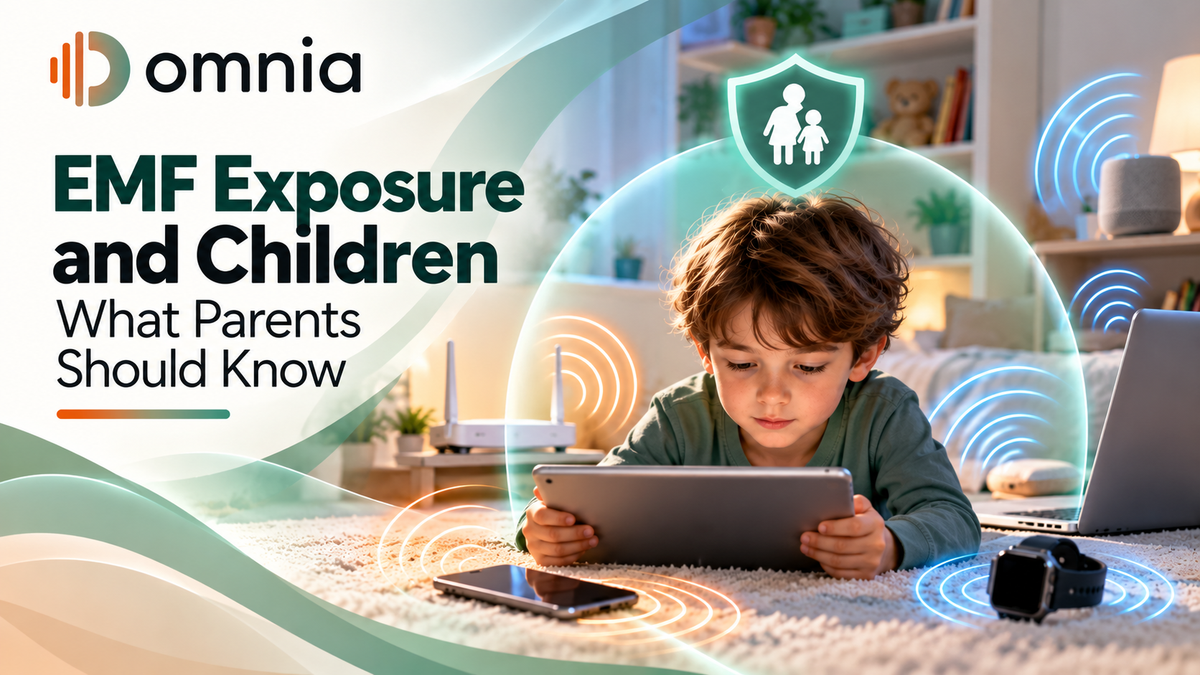
Children today are being raised with lifelong wireless exposure in a way no previous generation ever experienced. Tablets in the classroom, laptops for homework, smartphones by the time they hit their teens, and WiFi running through the house around the clock. It is a very different starting point than the one their parents grew up with, and it is one of the main reasons EMF exposure and children has become such a common search for concerned parents.
This guide covers why children's bodies may respond differently to wireless radiation than adult This guide looks at why children's wireless exposure is receiving attention, how kids encounter EMF across a typical day, and what parents can realistically do about it without removing devices from family life entirely.
Why Children May Be More Affected by Wireless Radiation
Omnia's ebook highlights several physical differences between children and adults when discussing why children's wireless exposure may deserve additional consideration.

The ebook points to children's smaller bodies and thinner skulls, higher water content and continuing physical development as reasons Omnia believes children's exposure deserves particular attention. These factors form part of Omnia's precautionary position rather than establishing that everyday wireless exposure causes harm to children.
None of this means that everyday wireless devices have been established as dangerous to children. Instead, Omnia uses these considerations to support a precautionary approach focused on the three factors discussed throughout its ebook: exposure time, proximity and signal strength.
How Kids Actually Encounter Wireless Radiation Day to Day
It rarely comes from one obvious source. A typical day for a school aged child might include a tablet or laptop used at school for several hours, a laptop for homework in the evening, a phone for messaging friends once they reach the age most kids get one, wireless earbuds or headphones for classes, gaming or music, and a home WiFi router that never turns off. Add in a family car with built in wireless connectivity, smart speakers around the house, and increasingly common wireless baby monitors for younger siblings, meaning children can encounter multiple wireless sources throughout a typical day without families necessarily thinking about each one individually.
Proximity is also worth considering. A child may use a tablet on their lap, wear wireless earbuds for extended periods or keep a phone close to the bed overnight. Combined with school, homework and entertainment, these habits can result in long periods spent close to wireless devices.
Want to explore EMF protection in more detail?
Download Omnia's eBook, EMF Radiation: Top 10 Reasons Why You Need To Protect Your Body, for a deeper look at EMF radiation, wireless exposure and the reasons behind Omnia's approach.
Specific Devices Worth Paying Attention To
Tablets and laptops used for school. These devices are often used at very close range, sometimes literally on a child's lap, for hours at a stretch during both school hours and homework time. Our guide on laptop EMF radiation risks and solutions for families goes deeper into this specific device and the exposure patterns unique to laptop use.
Wireless earbuds and headphones. Increasingly common for online classes, gaming and music, wireless earbuds sit directly in or against the ear for extended periods, making proximity an important factor to consider.. Our guide to EMF protection for earbuds walks through setup step by step for this exact use case.
Smartphones. Once a child has their own phone, the device may remain close to them for significant periods throughout the day and sometimes overnight.
Home WiFi routers. Home WiFi routers typically broadcast wireless signals throughout the day, making their location within the home another factor parents may wish to consider.
Wireless baby monitors. Wireless baby monitors can operate for long periods near where babies sleep. Parents concerned about proximity may wish to follow manufacturer guidance while positioning the monitor as far from the cot as practical for safe and reliable monitoring
What the Research Says, Carefully
It is easy for this topic to tip into fear, and that is not helpful for parents trying to make sensible, informed decisions. Some research and reports have investigated potential biological effects associated with radiofrequency exposure, including questions relating to children. Omnia's ebook argues that children's physical development and potentially longer lifetime exposure justify a precautionary approach. These concerns should be considered alongside the wider scientific evidence and established safety guidance.
It is a different thing entirely to say that wireless devices are proven to cause specific harm to children, which is not an established scientific fact and should not be presented as one. The responsible position is awareness plus practical steps, not alarm, and this guide is written with that balance in mind.
What Parents Can Do Without Taking Devices Away
Nobody is suggesting families throw out their laptops or ban tablets outright, and that is not realistic given how school and modern family life actually work. What most parents are looking for is a way to reduce the exposure that comes with devices their kids are already using every day, without disrupting school work, social connection or entertainment.
Simple habits help as a starting point. Keeping laptops off laps and on a desk or table where possible reduces direct proximity. Encouraging regular screen breaks reduces total exposure time. Moving phones and tablets away from the bed at night can reduce the amount of time children spend in close proximity to active wireless devices while sleeping. Positioning the home WiFi router away from bedrooms and common seating areas, where practical, reduces passive background exposure for the whole family.
Alongside practical habits, some parents also choose products marketed for managing EMF exposure. Omnia's ORB Sticker Family Pack is designed for devices including phones, laptops, tablets and WiFi routers, while the compact ORB MiCRO is designed for smaller devices such as headphones, earbuds and smartwatches.. Omnia's ORB Sticker Family Pack covers phones, laptops, tablets and the home WiFi router in one set, sized for exactly the kind of multi device household most families with school aged children are managing. The compact ORB MiCRO is designed specifically for headphones and earbuds, which is exactly where kids spend a lot of close, sustained device time during online school, gaming or video calls with friends.
How Omnia's Approach Works for Family Devices
Omnia describes its technology as a harmonising rather than blocking approach. According to the company, its ORB products are designed to work with the vibrational characteristics of the electromagnetic field without blocking the wireless signal. Omnia provides supporting material and testing relating to its approach, including heart rate variability, live blood analysis and water structure testing, which readers can review through the Omnia Test Results page.
Setting Family Device Rules Without a Fight
Reducing EMF exposure at home works best when it is built into routines the whole family already follows, rather than introduced as a new set of restrictive rules. A few approaches tend to work well in practice.
Charging stations outside bedrooms. Setting up a shared charging spot in a hallway or kitchen, rather than in each child's bedroom, naturally keeps phones and tablets further away overnight without needing to enforce a nightly negotiation.
Screen time that is already scheduled. Many families already have homework time, gaming time and downtime built into the day. Layering device distance habits, such as using a laptop at a desk instead of on a bed, onto routines that already exist is easier than introducing something entirely new.
Talking to the school about device policy. If children use school issued laptops or tablets for several hours each day, parents can ask about screen breaks, device positioning and healthy technology habits during lessons.
Explaining the reasoning to older kids. Teenagers in particular respond better to understanding why a habit matters than to being told what to do. Explaining that proximity and exposure time are the two factors most within their control, in simple terms, tends to land better than a blanket rule with no explanation attached.
Using a harmoniser alongside everyday habits. For parents who choose to use an EMF harmoniser, Omnia's ORB stickers are designed to remain attached to devices such as laptops, tablets and routers, meaning children do not need to remember an additional daily step.
What to Watch for as Kids Get Older
Device habits tend to shift significantly as children move from primary school into their teenage years, and each stage brings a different EMF exposure pattern worth being aware of.
Younger children's device use is often more supervised and may involve tablets or other devices provided by parents or schools. Because these devices can be held close to the body, encouraging sensible positioning from an early age can help establish practical device habits.
As children move into their pre teen and teenage years, personal smartphones, social messaging and gaming can become a larger part of everyday device use. This makes habits around device proximity and overnight use increasingly relevant.
Download the Omnia EMF Protection eBook
Want to learn more about EMF radiation and the reasons behind a precautionary approach to wireless exposure?
EMF Radiation: Top 10 Reasons Why You Need To Protect Your Body
Older teenagers may use several wireless devices throughout the same day, including phones, laptops, wireless earbuds and gaming equipment. Involving teenagers in conversations about practical device habits can help them understand why exposure time and proximity are worth considering.
FAQs About EMF Exposure and Children
Are children more exposed to EMF radiation than adults?
Children are not necessarily exposed to more EMF than adults. Omnia's ebook highlights physical differences including thinner skulls, higher water content and developing organs as reasons the company believes children's exposure deserves additional consideration. This does not establish that children are harmed by everyday wireless exposure.
Why are parents concerned about EMF exposure and children?
Parents are concerned because kids now use wireless devices from a very young age and for many hours a day, often starting well before their bodies have finished developing, which is a very different exposure pattern than previous generations experienced growing up.
Does distance from wireless devices matter for children?
Distance affects exposure to radiofrequency fields, which is why proximity is one of the factors discussed in Omnia's ebook. Practical habits such as using laptops on desks rather than laps can increase the distance between a child and an active wireless device.
How can families reduce everyday wireless exposure?
Families can manage everyday exposure by reducing unnecessary device time, increasing distance where practical, keeping active devices away from beds and considering where WiFi equipment is positioned. Some families may also choose EMF products alongside these practical habits.
What devices should be prioritized for a family with kids?
A useful starting point is the devices children use most frequently and keep closest to their bodies, such as tablets, laptops, phones and wireless earbuds.
Is it safe for a baby monitor to be placed near a crib?
Wireless baby monitors can operate for long periods close to where babies sleep. Parents concerned about proximity can follow the manufacturer's safety instructions and position the monitor as far from the cot as practical while maintaining reliable monitoring.
Will EMF protection products slow down my child's laptop or tablet?
Omnia says its ORB products use a harmonising approach rather than blocking the wireless signal. According to the company, this means they are designed to be used without interfering with normal device connectivity.
A Word on Balance for Busy Parents
None of the steps in this guide require a complete lifestyle overhaul, and that is intentional. Most parents already have a full plate managing school schedules, meals, activities and everything else that comes with raising kids, and adding a complicated new EMF avoidance routine on top of that is not realistic for most households. The habits outlined above, keeping laptops off laps, moving devices away from beds at night, and positioning the router thoughtfully, take almost no ongoing effort once they become part of the daily routine. For parents who choose an EMF harmoniser, Omnia's products are designed to remain attached to everyday devices without requiring an additional daily routine.
Protecting the Devices Your Kids Already Use
You do not need to overhaul how your family lives to take this seriously. Start with the devices your children touch every single day. Browse Omnia's full EMF protection range for family friendly packs covering phones, laptops, tablets, WiFi routers and earbuds, or read the FAQs to see exactly which product fits which device before you choose.
Share and get 15% off!
Simply share this product on one of the following social networks and you will unlock 15% off!