

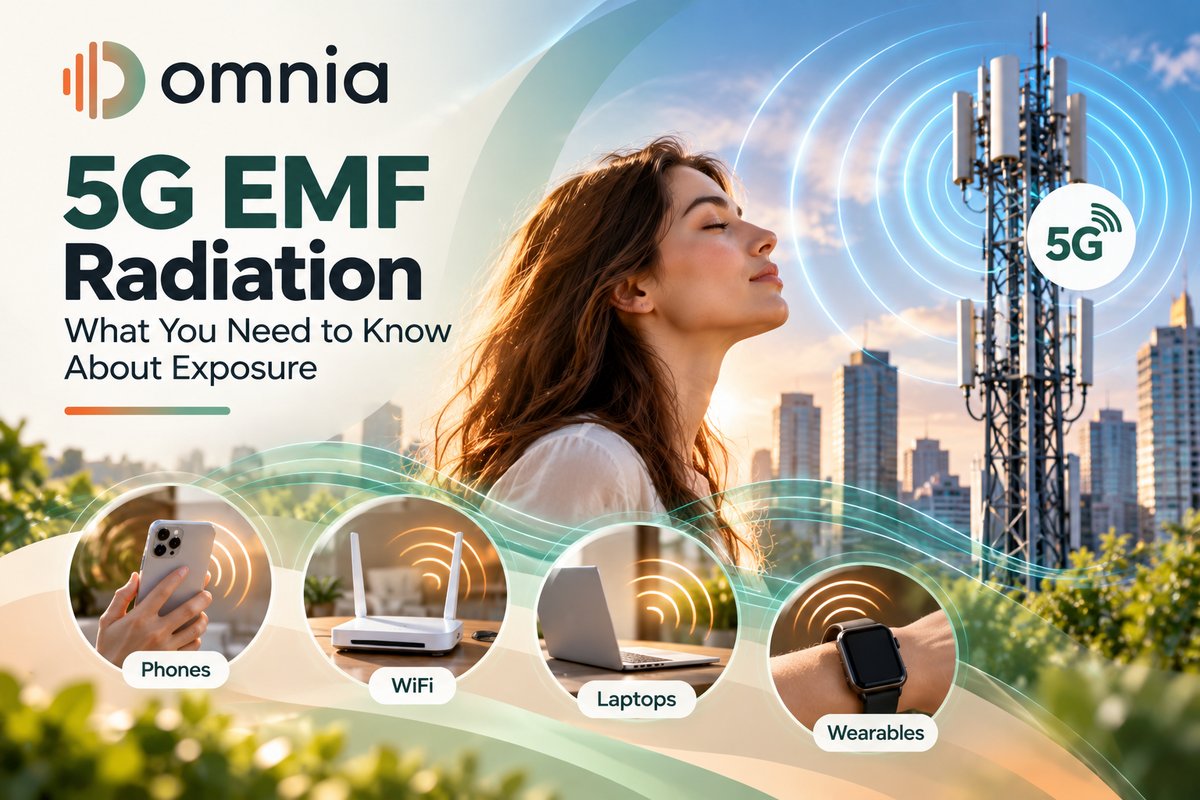
The continued rollout of 5G, alongside the development of future wireless technologies such as 6G, is changing the wireless environment around us. Phones, WiFi routers, laptops, wearables and connected devices are now part of everyday life, making radiofrequency exposure an increasingly common feature of modern environments.
Omnia's EMF ebook raises an important question around this changing landscape: as wireless technology continues to develop, what does long term exposure mean for the human body?
There is still scientific debate around some of these questions. That does not mean 5G has been proven to cause specific health problems, but it does mean research into radiofrequency exposure continues as technologies and patterns of use evolve.
This guide explores 5G EMF radiation, what current classifications mean, the questions Omnia raises about exposure and testing, and practical considerations for people interested in everyday wireless exposure and EMF protection.
Want to explore EMF protection in more detail?
Download Omnia's eBook, EMF Radiation: Top 10 Reasons Why You Need To Protect Your Body, for a deeper look at EMF radiation, wireless exposure and the reasons behind Omnia's approach.
Why 5G Is Different From Previous Wireless Generations
Wireless technology has developed considerably across successive generations, from 2G and 3G through 4G and now 5G.

5G can operate across different radiofrequency bands depending on the network and location. These include frequencies already familiar from previous mobile technologies as well as higher frequency bands.
Different frequency bands also behave differently. Higher frequency signals generally have shorter ranges and different propagation characteristics, which can influence how networks are designed and deployed.
For Omnia, the broader issue is not simply 5G itself. It is the increasing number of wireless devices, networks and radiofrequency sources people encounter throughout everyday life.
The original ebook describes wireless exposure as increasingly difficult to avoid, occurring not only through devices we personally use but also through WiFi networks and wireless infrastructure in homes, workplaces, schools and public spaces.
What Research Says About EMF and 5G
Research has investigated potential biological effects associated with exposure to radiofrequency electromagnetic fields, including animal studies.
Omnia's ebook specifically references research associated with the National Toxicology Program and the BioInitiative Report when discussing potential biological effects. It highlights findings reported in some animal research involving outcomes such as oxidative stress, DNA damage and other biological changes.
These findings should be considered within the wider scientific evidence rather than treated as proof that everyday 5G exposure causes particular health conditions in humans.
Long term effects of evolving patterns of wireless exposure continue to be researched.
For people concerned about that uncertainty, a precautionary approach can focus on practical factors that are easier to control, particularly how long wireless devices are used and how close they are kept to the body.
Understanding Non Ionising Radiation
Radiofrequency electromagnetic fields used by mobile phones, WiFi and 5G networks are classified as non ionising radiation.
This means they do not carry enough energy to ionise atoms or directly break chemical bonds in the way higher energy ionising radiation, such as X rays and gamma rays, can.
Omnia's ebook questions whether focusing predominantly on established heating effects tells the entire story. It points to animal research investigating biological effects beyond heating and argues that these findings deserve further investigation.
This is an important distinction.
It should not be interpreted as evidence that the established electromagnetic spectrum classification is wrong. Instead, it reflects Omnia's position that potential biological interactions beyond established thermal effects should receive greater attention and research.
Questions Around EMF Safety Standards
Another issue raised prominently in Omnia's ebook concerns the standards used to assess exposure to radiofrequency electromagnetic fields.
Organisations including the International Commission on Non Ionising Radiation Protection, or ICNIRP, publish guidelines for limiting exposure to electromagnetic fields.
Omnia questions whether existing approaches to exposure limits fully address the changing wireless environment, particularly as the number of connected devices and wireless sources around people has increased.
The ebook contrasts today's wireless environment with earlier generations of mobile technology and argues that changes in technology and patterns of use justify continued investigation into long term exposure.
Some researchers and advocacy organisations have raised similar questions about whether additional biological mechanisms should be considered alongside established effects.
For consumers, the important point is that questions around EMF exposure continue to be researched and debated as wireless technology develops.
How Wireless Device Exposure Is Assessed
Omnia's ebook also raises questions about how wireless devices and newer network technologies are tested.
One measurement commonly associated with wireless devices is Specific Absorption Rate, or SAR. It relates to the amount of radiofrequency energy absorbed by the body under defined testing conditions.
The ebook argues that conventional testing does not investigate every biological mechanism that Omnia believes should be considered. It also references a US Senate hearing concerning questions around 5G health and safety testing.
This forms part of Omnia's broader position that research into radiofrequency exposure should look beyond heating effects alone.
It is important, however, to distinguish that position from saying that 5G has been demonstrated to cause specific health effects. Those are not the same claim.
The Three Factors Behind Everyday EMF Exposure
One of the most useful frameworks in Omnia's ebook is much simpler than the scientific debate.
It identifies three main factors to consider when thinking about everyday wireless exposure:
Exposure Time
How long are you spending close to wireless devices each day?
Phones, laptops, tablets and wireless headphones can be used for hours at a time, making duration an important consideration.
Proximity
How close is the wireless device to your body?
Holding a phone against your head, carrying it in a pocket, placing a laptop directly on your lap or wearing wireless earbuds all involve close proximity to a wireless source.
Signal Strength
Radiofrequency output can vary depending on the device, network conditions and how the technology is being used.
These three factors form a central part of the original ebook's approach to understanding everyday EMF exposure.
Practical Ways to Manage Everyday Wireless Exposure
You cannot personally control the development of 5G networks, and most people are not going to stop using phones, laptops or WiFi.
You can, however, make practical choices about how you use wireless technology.
Increasing the distance between your body and a device when practical is one option. Using speaker mode or wired headphones for longer calls can reduce the amount of time a phone is held directly against the head.
Keeping laptops on a desk rather than directly on the body is another simple change.
Phones and other wireless devices can also be moved further away from the bed overnight when they do not need to be within immediate reach. Omnia recommends turning everything off at night because these EMF do not need to be hitting your body while you are sleeping.
These actions focus on two of the most straightforward factors identified in Omnia's ebook: time and proximity.
Where Omnia Radiation Balancer Technology Fits In
Omnia takes a different approach from conventional shielding products.
Rather than claiming to block wireless signals, the company describes its ORB technology as a harmonising technology.
According to Omnia, its proprietary Deca Energy technology is designed to work with the vibrational characteristics of the electromagnetic field while allowing phones, laptops, tablets and other wireless devices to remain connected and functional.
This proposed mechanism is part of Omnia's own scientific model and should be understood as the company's explanation of how its technology works.
Omnia provides supporting material and testing relating to its technology, including heart rate variability, live blood analysis and water structure testing, for customers who want to explore the company's evidence and methodology in more detail.
Learn How Omnia Technology Works
EMF Shielding vs Harmonising Technology
There are different approaches marketed to people concerned about wireless exposure.
Shielding products use materials designed to attenuate radiofrequency electromagnetic fields. Depending on the product, these can include specialist fabrics, paints, enclosures and device accessories.
Faraday enclosures take shielding further by creating an enclosure designed to prevent electromagnetic signals from passing through. Because this can also prevent wireless communication, it is generally suited to situations where a device does not need to remain connected or to be receiving data.
Other products, including crystals and mineral based products, are also marketed for EMF protection, although their proposed mechanisms and supporting evidence can vary considerably.
Harmonising products are positioned differently.
ORB products do not block the wireless signal. Instead, the Deca Energy technology imprinted in our products works with the vibrational characteristics of the electromagnetic field.
This allows Omnia's products to be used while devices remain connected, which is why the company offers products designed for phones, laptops, WiFi routers, headphones and wearable devices.
Which Devices Should You Consider First?
For most people, a useful starting point is to consider the wireless devices they use most frequently and keep closest to their bodies.
That could include:
Smartphones
Smartphones are frequently held, carried in pockets and touched throughout the day.
Laptops
Laptops can be used for several hours at close range. When we touch the keyboard, we touch the EMF.
Wireless Earbuds and Smartwatches
Wireless earbuds and smartwatches are designed to remain directly against or very close to the body.
WiFi Routers
WiFi routers typically operate for long periods and are often left switched on continuously.
Omnia's product range is structured around many of these everyday devices.
Its ORB Sticker Packs are designed for products such as phones, laptops, tablets and routers, while the smaller ORB MiCRO is designed for devices including headphones, earbuds and smartwatches.
What About 6G?
Wireless technology will continue to evolve.
Research and standardisation work relating to future wireless generations such as 6G is already underway, although the final technologies, frequencies and network configurations involved will continue developing.
Omnia's ebook uses this continuing evolution as part of its argument for becoming more aware of everyday wireless exposure now rather than waiting for future generations of technology.
The practical point does not require predicting exactly what 6G will look like.
Wireless technology is already embedded in everyday life, so understanding how frequently you use devices and how close you keep them to your body can be useful regardless of which generation of wireless network is operating.
Download the Omnia EMF Protection eBook
Want to learn more about EMF radiation and the reasons behind a precautionary approach to wireless exposure?
EMF Radiation: Top 10 Reasons Why You Need To Protect Your Body
FAQs About 5G EMF Radiation
What Is 5G EMF Radiation?
5G networks use radiofrequency electromagnetic fields to transmit information wirelessly. The frequencies used vary according to the particular network and deployment.
Is 5G Radiation Ionising or Non Ionising?
Radiofrequency electromagnetic fields used by 5G are classified as non ionising radiation. They do not have enough energy to directly ionise atoms in the way X rays and gamma rays can.
Has 5G Been Proven to Cause Health Problems?
This article does not claim that 5G has been proven to cause specific health conditions. Research into radiofrequency exposure continues, and Omnia's ebook highlights studies and questions that the company believes deserve further investigation.
What Factors Affect My Everyday EMF Exposure?
Omnia's ebook focuses on three main factors: exposure time, proximity and signal strength. How long you use a wireless device and how close it is to your body are two practical factors that can often be changed relatively easily.
How Can I Reduce Unnecessary Wireless Exposure?
Practical steps can include increasing your distance from wireless devices when possible, avoiding keeping active devices directly against the body unnecessarily and moving devices further away while sleeping.
What Is the Difference Between an EMF Blocker and an EMF Harmoniser?
Shielding products are designed to attenuate electromagnetic fields. Omnia describes its harmoniser technology differently. According to the company, its products are designed to work with the vibrational characteristics of the electromagnetic field rather than blocking the wireless signal.
Does an Omnia ORB Reduce My Phone or WiFi Signal?
Omnia says its ORB technology is designed to work without blocking the wireless signal, allowing devices to continue operating normally. This is part of Omnia's description of how its proprietary Deca Energy technology works.
Making Informed Choices in a Wireless World
5G is part of a much broader shift towards an increasingly connected world.
Omnia's position is that people should be able to understand the wireless environment around them, explore the available research and make informed decisions about their own everyday exposure.
You do not need to give up modern technology to start thinking about exposure time and proximity. Small practical changes can be made around the devices you already use every day.
For people who want to explore Omnia's approach further, the company also offers its range of ORB products based on its proprietary Deca Energy technology.
Explore Omnia's full EMF protection range
Share and get 15% off!
Simply share this product on one of the following social networks and you will unlock 15% off!